Picture this: You’re settling into your seat at the local cinema, the lights dim, and a colossal image fills your view. Then, the sound washes over you – dialogue perfectly centered with the actors, explosions rumbling from the heart of the action, music swelling from every corner of the room. It’s an immersion that home theaters often struggle to replicate, primarily because of a fundamental design secret: where the main speakers are placed.
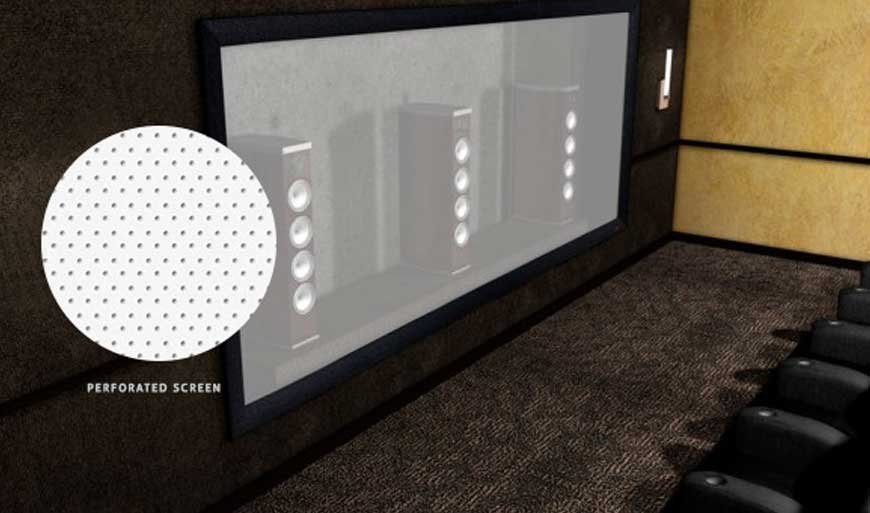
Unlike your living room setup, those massive movie screens in commercial theaters aren't just for visuals. Hidden directly behind that gigantic canvas are the front-channel speakers, delivering dialogue and primary sound effects directly from the picture. This magical feat is possible thanks to perforated projector screens, and they're the missing ingredient for bringing true cinematic audio and visual harmony into your own home theater.
At a Glance: What You Need to Know About Perforated Projector Screens
- Audio Immersion: Allows you to place speakers behind the screen, just like commercial cinemas, for perfect audio-visual synchronization.
- Acoustically Transparent: Sound passes through the screen material with minimal distortion or attenuation.
- Uncompromised Picture: Modern perforated screens maintain superb image quality, even with 4K/UHD resolutions.
- Maximizes Screen Size: Eliminates the need for speaker placement to the sides or below the screen, letting you install a larger display.
- Cleaner Aesthetics: Conceals speakers for a sleek, professional home theater look.
- Two Main Types: Micro-perforated (tiny holes) and woven (fabric-like mesh).
- Moiré Effect: A potential issue with some perforated screens and projectors, but largely mitigated by advanced materials and proper setup.
The Unseen Secret: How Cinemas Perfect Their Sound
Think about it: in a commercial movie theater, where do you imagine the dialogue comes from? It sounds like it's coming directly from the actors' mouths on screen, doesn't it? That's because it is. Standard home theater setups often place the center channel speaker below or above the screen, or the left/right speakers to the sides. While this works, it creates a disconnect: your eyes see the sound originating from one place, but your ears perceive it coming from another. This subtle disharmony breaks the illusion of reality.
For decades, professional cinemas have bypassed this problem by employing acoustically transparent screens. These specialized screens feature thousands of microscopic perforations or a precisely woven fabric structure that allows sound waves to pass through unhindered. This enables the crucial placement of the main front speakers – the left, center, and right channels – directly behind the screen, perfectly aligned with the visual action. The result is a soundstage that is precisely anchored to the image, delivering an incredibly immersive and natural listening experience. You get true dialogue localization, sound effects that emanate from their visual source, and an overall sonic coherence that’s simply unmatched.
What Makes a Screen "Acoustically Transparent"?
The term "acoustically transparent" might sound high-tech, but the concept is straightforward: the screen material is designed to be permeable to sound waves without degrading the projected image. There are generally two primary technologies used to achieve this:
- Micro-Perforated Screens: These screens feature thousands of tiny, precisely drilled holes across their surface. The perforations are typically so small – often less than a millimeter in diameter – that they are virtually invisible from normal viewing distances. The sound waves easily pass through these holes, while the light from the projector reflects off the remaining solid surface, creating the image. The key is ensuring the holes are small enough not to be noticeable, yet numerous enough to allow sufficient sound transmission.
- Woven (Fabric) Screens: Instead of holes, these screens are made from a specially woven fabric material. The weave is designed with microscopic gaps between the threads, forming a breathable mesh. This allows sound to pass through, much like a fine speaker grille, while providing a smooth, reflective surface for the projected image. Modern woven materials are engineered to be incredibly dense and uniform, ensuring exceptional picture quality compatible with even HD holed and 4K resolutions.
Both approaches aim for the same goal: sound passes through with "minimal attenuation" (meaning very little loss of sound energy or clarity) while maintaining pristine visual quality.
Why You Absolutely Need One: The Unbeatable Benefits
Upgrading to a perforated projector screen isn't just about a subtle improvement; it's about fundamentally transforming your home theater into a more authentic and immersive cinematic environment.
Immersive Audio: Sound That Wraps Around You
This is the big one. By placing your left, center, and right speakers directly behind the screen, you create a "phantom center" effect where dialogue and on-screen sounds are perfectly anchored to the action. No more dialogue floating above or below the screen! It elevates your surround sound experience, making explosions feel like they're coming from the exact spot a car blows up, and voices sound like they're truly emanating from the character speaking. This audio-visual synergy is critical for true immersion, allowing your brain to fully suspend disbelief and get lost in the film.
Maximize Your Screen Size & Aesthetics
One of the biggest challenges in home theater design is fitting everything into the space. Traditional setups require you to leave room on either side or below the screen for your main speakers. A perforated screen liberates you from this constraint. You can run your screen edge-to-edge, from floor to ceiling, or wall-to-wall, fitting the largest possible screen into your dedicated space.
Beyond the practicalities, there's the aesthetic benefit. Imagine a clean, minimalist home theater where the speakers are completely hidden from view. No unsightly boxes, cables, or grilles cluttering your front wall. This creates a much more polished and professional look, truly replicating the sleek, uninterrupted visual experience of a commercial cinema.
Uncompromised Picture Quality
A common misconception is that adding holes or a weave will degrade the image. While early acoustically transparent screens sometimes faced challenges with moiré patterns or reduced brightness, modern screens have largely overcome these issues. Advances in material science mean today's perforated and woven screens offer:
- UHD/4K Compatibility: High-quality materials are designed to be "moiré-free" and compatible with the pixel density of Ultra-High Definition and 4K projectors.
- Excellent Uniformity: Light is diffused evenly across the surface, ensuring consistent brightness and color accuracy from various viewing angles.
- Minimal Light Penetration: Dense weaves and precise perforations prevent significant light from passing through the screen, reflecting more light back to the viewer for a brighter, more vibrant image.
Many premium brands like Elite Screens offer acoustically transparent materials specifically engineered for reference quality images, proving that you no longer have to sacrifice visual fidelity for superior sound.
Weave vs. Micro-Perforated: Understanding the Materials
When diving into the world of acoustically transparent screens, you'll primarily encounter two distinct material approaches: woven and micro-perforated. Each has its nuances, making it important to understand their differences when making your choice.
Woven Acoustic Screens
- How they work: These screens are made from specially engineered fabric with a precise, open weave that allows sound to pass through. Think of it like a very fine mesh.
- Key Characteristics:
- Moiré Resistance: Generally, woven screens are less prone to moiré patterns, especially with lower-resolution projectors, because the weave structure is less uniform than a grid of holes. This makes them a popular choice for a wide range of projector resolutions.
- Sound Transparency: Excellent sound pass-through due to the consistent open-mesh structure.
- Visual Texture: Some woven screens might exhibit a very subtle texture up close, though this is usually invisible from normal viewing distances.
- Light Penetration: Often have good light reflection characteristics while minimizing light leakage through the material.
- Best for: Most home theater applications, especially when concern about moiré is high, or when using a projector with a lower pixel pitch relative to the screen size.
Micro-Perforated Screens
- How they work: These screens are solid surfaces with thousands of tiny, precision-drilled holes.
- Key Characteristics:
- Smooth Surface: Visually, they can appear almost completely smooth, similar to a non-perforated screen, as the holes are incredibly small.
- Potential for Moiré: Micro-perforated screens can sometimes be more susceptible to the moiré effect, especially with very high-resolution projectors (4K and beyond) where the screen's perforation pattern can interact with the projector's pixel grid. However, advanced manufacturing techniques and extremely small hole sizes have significantly reduced this risk in premium screens.
- Sound Transparency: Very good, though the percentage of open area might be slightly less than some woven options, requiring careful design to ensure sufficient sound pass-through.
- Gain: Often available in a wider range of gain values compared to woven screens.
- Best for: Installations where a perfectly smooth visual surface is paramount, and when paired with projectors and viewing distances carefully considered to avoid moiré.
The choice between woven and micro-perforated often comes down to your specific projector, viewing distance, and personal preference for visual characteristics. Many manufacturers now offer "acoustic transparent" options that perform exceptionally well in both categories.
Choosing Your Ideal Perforated Screen: Key Considerations
Selecting the right perforated projector screen involves more than just picking a size. Here's what to keep in mind to ensure you get the best performance for your home theater.
Moiré Effect: Your Resolution & Screen Weave
This is perhaps the most talked-about technical consideration for acoustically transparent screens. Moiré is a wavy, interference pattern that can appear on screen when the regular pattern of the screen's perforations or weave interacts with the regular pixel grid of your projector. It looks like subtle ripples or shimmering lines on the image.
How to Mitigate Moiré:
- High-Quality Screen Material: Premium screens are designed with very fine perforations or weaves that are difficult for the projector's pixel structure to "resolve," minimizing moiré.
- Screen-to-Projector Compatibility: Some manufacturers specify recommended minimum viewing distances or compatible projector resolutions for their AT screens.
- Pixel Shifting Projectors: Projectors that use pixel shifting technology (e.g., 4K enhancement) can sometimes be less prone to moiré due to their non-static pixel patterns.
- Projection Angle: Experimenting with the projector's tilt or offset can sometimes help.
- Viewing Distance: The further you sit from the screen, the less noticeable any potential moiré will be.
Don't let the fear of moiré deter you. With modern screens and proper planning, it's often a non-issue.
Screen Gain & Viewing Angle
- Screen Gain: This refers to how reflective the screen material is. A gain of 1.0 means it reflects light uniformly. Higher gain (e.g., 1.2, 1.5) makes the image brighter, which can be useful in rooms with some ambient light or with lower-brightness projectors. However, very high gain screens can suffer from "hot-spotting" (a noticeable bright spot in the center) and narrower viewing angles. Lower gain (e.g., 0.8) can enhance contrast, especially in very dark rooms.
- Viewing Angle: This is the range within which the screen maintains optimal brightness and color uniformity. Acoustically transparent screens generally have good viewing angles, but it's worth checking specifications, especially if your seating arrangement is wide. Elite Screens, for example, highlights "wide diffusion uniformity" for its AT materials, ensuring superb picture quality even off-axis.
Material Durability & Maintenance
Like any screen, you'll want a material that can withstand the test of time. Look for:
- Tensioning Systems: Fixed-frame screens should have robust tensioning to keep the surface perfectly flat, preventing wrinkles or waves.
- Easy Cleaning: Ensure the material is easy to clean without damaging the perforations or weave.
- Mould/Mildew Resistance: Especially important in humid environments.
Fixed Frame vs. Retractable
- Fixed Frame: The most common choice for acoustically transparent screens. These screens are stretched taut over a rigid frame, ensuring a perfectly flat, ripple-free surface. They offer the best long-term performance and are ideal for dedicated home theaters where the screen remains permanently visible.
- Retractable (Motorized/Manual): While less common for AT screens, some manufacturers offer retractable options. These are convenient for multi-purpose rooms where the screen needs to disappear when not in use. However, achieving a perfectly flat surface when deployed can be more challenging than with fixed frames, which is critical for AT screens. Ensure any retractable AT screen has robust tensioning mechanisms (e.g., tab-tensioned) to minimize wrinkling.
Installation & Speaker Placement
Successfully integrating a perforated screen requires careful thought about speaker placement behind it.
- Speaker Type: In-wall speakers are often ideal as they can be flush-mounted behind the screen, minimizing depth. However, quality bookshelf speakers on stands or even floor-standing speakers can also work, provided you have enough depth behind the screen.
- Distance from Screen: Speakers shouldn't be too close to the screen material to avoid pushing against it or causing vibrations. A few inches of clearance is usually sufficient.
- Room Acoustics: Even with a perforated screen, proper room acoustics (treatments for reflections, bass traps) are still vital for the best sound quality. The screen helps with imaging, but the room defines the overall sound signature.
Common Questions & Misconceptions About Perforated Screens
Let's clear up some common concerns people have when considering acoustically transparent screens.
"Will the sound be muffled or distorted?"
No, not with a quality screen. Modern perforated and woven materials are designed to have minimal impact on sound quality. They allow sound to pass through with very little "attenuation" (loss) or distortion, ensuring the audio remains clear, dynamic, and true to its source. The tiny holes or weave are too small to scatter or absorb significant sound energy.
"Will I see the holes or weave?"
From typical viewing distances, you should not notice the perforations or weave. They are designed to be imperceptible. If you get very close to the screen, you might see them, but at your seating position, the image should appear solid and smooth. High-resolution projectors and larger screen sizes generally help mask any potential visibility of the material structure.
"Does it reduce picture brightness or contrast?"
Any material will absorb or reflect some light. However, quality perforated screens are engineered to maximize light reflection while minimizing light leakage. While there might be a minuscule difference compared to a truly solid screen of the exact same material and gain, this difference is usually imperceptible and far outweighed by the audio benefits. Many AT screens offer excellent gain and contrast, perfectly suited for dedicated dark-room home theaters.
"Are they only for high-end, expensive setups?"
While premium options exist, perforated projector screens are increasingly accessible for various budgets. As home theater technology has advanced, the cost of quality AT materials has become more competitive, making them a viable upgrade for many enthusiasts, not just the ultra-high-end market. The investment often pays for itself in the enhanced immersion and aesthetics.
The Next Chapter for Your Home Theater
If you're serious about creating a truly immersive home theater experience – one that genuinely rivals the magic of your favorite cinema – then a perforated projector screen is an indispensable component. It's the key to unlocking perfect audio-visual synergy, allowing sound to emanate directly from the on-screen action, while simultaneously providing a pristine, expansive image.
Moving forward, consider the dimensions of your room, your projector's capabilities, and your audio system. Research reputable screen manufacturers known for their acoustically transparent offerings. Don't hesitate to consult with home theater professionals who can guide you through the selection process, ensuring compatibility and optimal performance. Embrace the secret of the cinema, and prepare to be truly enveloped by your movies and shows.