For too long, home cinema enthusiasts have faced a frustrating dilemma: prioritizing pristine picture quality at the expense of optimal sound, or vice versa. Imagine watching a thrilling chase scene where the roaring engine sounds like it’s coming from your side speakers, rather than the car speeding across the screen. Or a tender dialogue where the actor’s voice seems detached from their lips. This is the compromise traditional setups often force upon us. But what if you could eliminate that trade-off entirely, achieving perfect harmony between sight and sound? Enter Acoustic Transparency in Home Cinema, the game-changer that allows you to place your most crucial speakers directly behind your projection screen, just like in a commercial movie theater.
This isn't just about hiding speakers; it's about perfecting the immersive experience, making every explosion, whispered secret, and soaring soundtrack element feel intrinsically linked to the visuals. It’s about building a cinematic reality where sound genuinely originates from the action on screen, blurring the line between watching a movie and truly being in it.
At a Glance: What You'll Learn About Acoustic Transparency
- What it is: A specialized projection screen material that lets sound pass through while maintaining a high-quality image.
- Why it matters: Perfects sound-to-picture alignment, making dialogue and effects come directly from the screen for unparalleled realism.
- Key benefits: Superior immersion, balanced sound, reduced distortion, and a clean, minimalist aesthetic.
- Two main types: Woven (best for home, 4K/8K-ready) and Perforated (more for large commercial setups).
- Optimal setup: Precise speaker placement, high-quality screen choice, careful audio calibration, and room acoustic considerations.
- Lumina Screens: Leading the way with advanced woven solutions like Accupix and Accupix Pro.
The "Why": Why Compromise When You Can Have Both?
The traditional home cinema setup often involves placing your left, center, and right (LCR) speakers around your screen. The center channel, especially, is critical for dialogue. When it’s placed below or above the screen, your brain works overtime trying to reconcile the audio cues with the visual information. You see a character speak on screen, but your ears tell you the voice is coming from a separate location. This subtle disconnect breaks immersion, even if you don't consciously realize it.
Acoustic Transparent (AT) screens fundamentally solve this problem. By allowing you to position your front soundstage speakers—especially the vital center channel—directly behind the screen, the audio's origin perfectly aligns with the visuals. The result isn't just "better sound"; it's a completely transformed, more believable, and deeply immersive experience.
Perfect Sound Alignment: Dialogue from the Actor's Mouth
Imagine watching a tense conversation. With an AT screen, the actors' voices emanate precisely from their mouths on screen. This isn't just an auditory trick; it's a fundamental aspect of how our brains process reality. When sight and sound align, our sense of presence skyrockets. Dialogue becomes clearer, more focused, and utterly natural, pulling you deeper into the narrative without any mental effort to connect visual and auditory cues.
An Immersive Soundstage: Audio Truly Comes from the Scene
Beyond dialogue, AT screens create a seamless, expansive soundstage. Sound effects, musical scores, and ambient noise spread across the screen's surface, mirroring the action. A car racing from left to right on screen will have its sound track that precise movement, rather than jumping between discrete speakers. This balanced sound distribution eliminates the unevenness and potential distortion that can arise from speakers placed in less-than-ideal positions around the room. The result is a coherent, lifelike audio landscape that wraps around you.
Aesthetic Purity: The Magic of Invisibility
Let's be honest: a home cinema should look as good as it sounds. Large, imposing speakers can be a significant visual distraction, cluttering your viewing space and competing with the clean lines of your carefully designed room. Acoustic Transparent screens make your speakers disappear. They free up precious wall real estate, allow for larger screen sizes, and create a sleek, minimalist aesthetic that speaks volumes about your commitment to premium entertainment without shouting it with visible hardware. This discreet integration offers unparalleled flexibility in room layout and design, ensuring your home cinema is a sanctuary of both sight and sound.
Peeking Behind the Curtain: How Acoustic Transparency Works
At its core, an Acoustic Transparent screen is a marvel of material science. It's engineered to be both visually opaque to projected light and acoustically porous to sound waves. Think of it like a finely woven mesh or a carefully perforated surface: light particles (photons) from your projector are reflected off its surface to create the image, while sound waves from the speakers behind it pass through with minimal attenuation or coloration.
The key is balancing these two competing requirements. The material must be uniform enough to prevent visible texture or "hot spots" in the image, yet open enough to let sound travel without being muffled or distorted. Modern AT screens achieve this through precision manufacturing, using micro-perforations or intricate weaving patterns that are virtually invisible to the viewer from a typical seating distance. This sophisticated design ensures that your picture remains vibrant and sharp, while your audio reaches your ears unimpeded.
Choosing Your Canvas: Types of Acoustic Transparent Screens
Not all AT screens are created equal. The technology primarily comes in two distinct forms, each with its own strengths and ideal applications. Understanding these differences is crucial for selecting the right screen for your specific home cinema setup.
Woven Acoustic Transparent Screens: The Home Cinema Champion
Woven AT screens are crafted from a specially designed fabric, often with incredibly fine threads that form a uniform, open weave. This construction offers several significant advantages, making them the preferred choice for dedicated home theatre enthusiasts:
- Superior Audio Transparency: The open weave allows sound to pass through with minimal obstruction, resulting in excellent acoustic performance and virtually no high-frequency roll-off. This means your sound remains clear, crisp, and natural.
- Minimal Moiré Patterns: Moiré is an interference pattern that can appear when a fine pattern (like pixels) interacts with another fine pattern (like screen perforations). Woven screens, with their inherent lack of perfectly regular holes, are far less susceptible to moiré, ensuring a pristine, artifact-free image.
- Ideal for High Resolution: Their smooth, consistent surface and lack of visible perforations make woven screens perfect for showcasing the sharp detail of 4K and even 8K projections without any pixel-level interference.
- Smooth Finish: The finely woven texture often provides a smoother, more uniform viewing surface, enhancing the overall picture quality and aesthetic appeal.
Companies like Lumina Screens, with their Accupix and Accupix Pro lines, exemplify the state-of-the-art in woven AT screen technology, offering solutions specifically designed for the demanding requirements of high-end home cinemas.
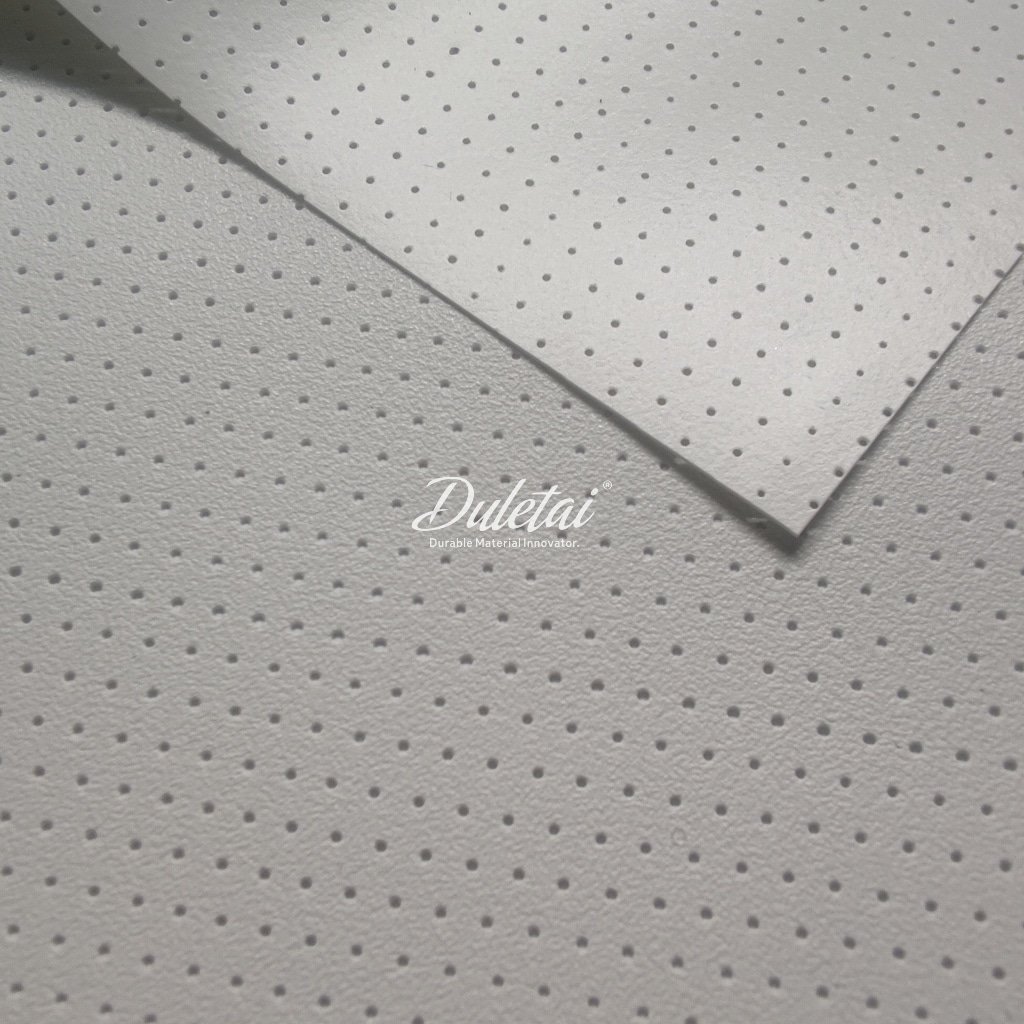
Perforated Acoustic Transparent Screens: The Commercial Workhorse
Perforated AT screens feature tiny, evenly spaced holes punched or laser-cut into the screen material. While effective and widely used in commercial cinemas, they come with a few considerations that make them generally less ideal for typical home theatre environments:
- Effective for Large Scale: The perforation method allows for very large screen sizes, which is necessary for massive commercial theaters where viewing distances are much greater.
- Potential for Moiré: Due to the precise, regular pattern of holes, perforated screens have a higher chance of exhibiting moiré patterns, especially with projectors that have a distinct pixel grid. This can be mitigated with careful projector-to-screen alignment and some lens shift, but it remains a potential concern for the closer viewing distances common in home settings.
- Requires EQ Tuning: The holes, while allowing sound through, can still cause some high-frequency attenuation. This often necessitates additional equalization (EQ) tuning from your AV receiver or sound processor to compensate and ensure balanced audio.
- Best for Professional Calibration: Because of the potential for moiré and the need for EQ, perforated screens are best suited for installations where advanced audio and visual calibration tools and expertise are readily available.
While perforated screens certainly have their place, especially in professional venues, for the discerning home cinema enthusiast, the woven variety typically offers a more seamless, higher-fidelity experience without the added complexities. To Learn more about hd holed screens and their commercial applications, you'll find there's a distinct engineering philosophy at play.
The Setup Masterclass: Maximizing Your Acoustic Transparent Experience
Installing an Acoustic Transparent screen isn't just about hanging it on the wall. To truly unlock its potential and achieve that coveted cinematic immersion, you need a holistic approach to your entire home cinema setup.
Speaker Placement: The Foundation of Immersion
This is perhaps the single most critical factor for an AT screen. The beauty of acoustic transparency is the ability to place speakers where they should be: directly behind the screen, aligned with the visuals.
- Center Channel is King: Your center channel speaker carries the majority of dialogue. It must be positioned directly behind the center of your screen, ideally at ear height for your primary listening position. This ensures dialogue is anchored precisely to the image.
- LCR Alignment: Your left and right front speakers should also be behind the screen, roughly aligning with the edges of the projected image (or slightly inside them, depending on your room and screen width). Aim for the tweeters of your LCR speakers to be at roughly the same height as the center channel.
- Clearance and Spacing: Ensure there's adequate space between the back of the screen and the front of your speakers. Speakers need room to "breathe" and project sound effectively. Avoid having speakers pressed right up against the screen material.
- Toe-in (Optional but Recommended): You might experiment with slightly "toeing in" your left and right speakers (angling them inwards) to point towards your main listening position, even behind the screen. This can optimize the soundstage.
Screen Selection: More Than Just a Fabric
Choosing the right AT screen material is paramount. As discussed, for home cinema, woven is generally preferred.
- Prioritize Woven for Home: For the best balance of audio transparency, image quality, and moiré resistance, opt for a high-quality woven screen.
- Resolution Compatibility: Ensure your chosen screen material is "4K & 8K-ready." Modern woven screens like Lumina Screens' Accupix and Accupix Pro are specifically engineered to handle the pixel density and sharpness of high-resolution projectors without introducing any unwanted visual artifacts.
- Gain and Viewing Angle: Consider the screen's gain (how reflective it is) and its viewing angle. Most AT screens have a neutral gain (around 1.0) and a wide viewing angle, which is ideal for maintaining consistent brightness and color uniformity for all viewers.
- Frame and Tensioning: A robust frame with excellent tensioning is crucial to keep the screen surface perfectly flat, preventing wrinkles or distortions that can mar your picture.
Audio Calibration: Fine-Tuning Your Sonic Landscape
Even the best AT screen will benefit from proper audio calibration. While woven screens have minimal impact on sound, some minor high-frequency attenuation can occur.
- AV Receiver/Sound Processor: Utilize the built-in auto-calibration features of your AV receiver or a dedicated sound processor (e.g., Audyssey, Dirac Live, MCACC, YPAO). These systems use a microphone to measure your room's acoustics and speaker output, automatically adjusting levels, distances, delays, and equalization.
- Manual Refinement: After auto-calibration, don't be afraid to fine-tune manually. Listen critically to dialogue clarity, bass response, and overall soundstage. You might gently boost high frequencies by 1-2 dB if you perceive any slight dullness, but usually, modern woven screens require very little compensation.
- Level Matching: Ensure all your speakers are outputting sound at the same perceived volume (SPL) at your main listening position. This is critical for seamless panning and balanced surround sound.
Room Acoustics: The Unsung Hero
An often-overlooked aspect, room acoustics play a massive role in how good your audio sounds, regardless of your screen type.
- Minimize Reflections: Hard, reflective surfaces (bare walls, glass, untreated ceilings) can cause sound to bounce around, leading to muddiness, echo, and reduced clarity.
- Acoustic Treatments: Incorporate acoustic panels (absorption and diffusion) on walls and ceilings to control reflections. Bass traps in corners are essential for taming low-frequency issues. Even heavy curtains and thick carpets can help.
- Strategic Placement: Place absorption panels at first reflection points (where sound from your speakers first hits a wall on its way to your ears). Diffusers can be used on the back wall to scatter sound, creating a more spacious feel.
Installation Precision: Measurements Matter
The physical installation of your AT screen and speakers requires careful planning and execution.
- Adequate Space: Ensure there's enough depth behind your screen to comfortably accommodate your speakers, their cables, and any necessary mounting hardware. Don't forget speaker grills and any back-firing ports.
- Wall Support: Projection screens, especially larger framed ones with speakers behind them, can be heavy. Verify that your wall or mounting structure can safely support the combined weight.
- Precision Alignment: The screen must be perfectly level and square to your projector. Any tilt or warp will distort the image. Ensure the screen is centered horizontally and vertically for optimal viewing.
Common Myths & Misconceptions About AT Screens
Despite their growing popularity, Acoustic Transparent screens sometimes face unfounded criticism or misunderstandings. Let's debunk a few common myths:
"They Ruin Image Quality."
Myth: Some believe that perforations or weaving patterns will be visible, leading to a degraded or pixellated image.
Reality: Modern woven AT screens, especially high-quality ones like Lumina Accupix, are engineered with such fine textures and precise manufacturing that they are virtually invisible from a typical viewing distance. They support 4K and 8K resolutions beautifully, delivering a sharp, vibrant, and artifact-free picture. Any perceived degradation is almost always due to using a low-quality screen, improper projector setup, or an incorrectly chosen screen type for the resolution.
"They Make Sound Muffled."
Myth: The idea that sound passing through a screen will inevitably be muffled or distorted.
Reality: While some high-frequency attenuation can occur with certain materials, especially older perforated designs, high-quality woven AT screens have incredibly high acoustic transparency. Any minimal frequency loss is easily compensated for with modern AV receiver calibration systems (like Audyssey or Dirac Live), which can fine-tune speaker output to ensure perfectly balanced and clear audio. The benefits of sound localization far outweigh any negligible acoustic impact.
"They're Only for High-End Setups."
Myth: Acoustic transparency is an exclusive feature only accessible to ultra-luxury home cinemas.
Reality: While it's true that premier AT screens represent a significant investment, the core benefits of perfect sound alignment and a clean aesthetic are universally desirable. As the technology matures, more accessible options are emerging. More importantly, the value it adds to the immersive experience is profound, making it a highly worthwhile upgrade for any dedicated home cinema, regardless of the overall budget. It's about prioritizing the cinematic experience, not just cost.
"Any Screen Can Be AT if You Poke Holes in It."
Myth: Some might think that DIY solutions like perforating a regular screen would achieve the same effect.
Reality: Acoustic Transparent screens are products of sophisticated engineering and material science. The size, shape, and spacing of perforations, or the specific weave pattern of a fabric, are meticulously designed to maximize both acoustic transparency and optical performance. Randomly poking holes or using a generic mesh will almost certainly result in visible artifacts, poor image quality (hot-spotting, visible patterns), and compromised sound, often sounding worse than no AT screen at all. It’s a specialized product for a reason.
The Lumina Screens Advantage: Crafting Your Cinematic Reality
When you're ready to embrace the full potential of Acoustic Transparency, choosing a reputable and innovative manufacturer makes all the difference. Lumina Screens stands out as a leader in this specialized field, offering premier AT solutions designed with the discerning home cinema enthusiast in mind.
Their Accupix and Accupix Pro lines are not just projection screens; they are meticulously engineered components of a truly immersive cinematic system. Here's what sets them apart:
- State-of-the-Art Woven Structure: Lumina's screens utilize a finely woven fabric that represents the pinnacle of AT material science. This design ensures exceptional audio transparency, allowing sound to pass through with virtually no distortion or high-frequency roll-off.
- Exceptional 4K & 8K-Ready Clarity: The Accupix materials are specifically optimized for high-resolution projection. Their uniform, smooth surface prevents moiré patterns and maintains incredible sharpness, vibrancy, and color accuracy, ensuring your 4K and even future 8K content looks stunning.
- Enhanced Durability: Built to last, Lumina screens offer robust construction and superior tensioning systems. This guarantees a perfectly flat, wrinkle-free viewing surface for years of reliable, high-performance entertainment.
- Seamless Integration: By enabling discreet speaker placement, Lumina screens help create that coveted minimalist aesthetic, where the technology fades into the background, leaving only the magic of the movie on display.
Investing in a Lumina Acoustic Transparent screen is an investment in a true cinematic experience—one where sound and picture are perfectly synchronized, and every moment on screen comes alive with unparalleled realism.
Ready to Transform Your Home Cinema?
The journey to an acoustically transparent home cinema is a leap towards truly immersive entertainment. It’s about more than just watching movies; it’s about experiencing them exactly as the filmmakers intended—with dialogue rooted to the screen, soundscapes that envelop you, and visuals that remain pristine. The days of compromising between exquisite picture and perfect sound are over.
If you're serious about elevating your home cinema, start by evaluating your current setup and room. Consider the benefits of a woven AT screen, recognizing it as the foundation for a superior audio-visual experience. Explore options like Lumina Screens’ Accupix and Accupix Pro, knowing that you're investing in cutting-edge technology designed for today's and tomorrow's high-resolution content.
Don't settle for sound that floats above or below the action. Embrace Acoustic Transparency and discover the profound difference it makes when your sound and picture finally align in perfect harmony, creating a cinematic reality right in your own home. The stage is set; all that's left is for you to step into the scene.